-
Categories
- Acronym (4)
- Angiography and Interventions (250)
- Cardiac CT scan (18)
- Cardiac Magnetic Resonance imaging (14)
- Cardiology MCQ (114)
- Cardiology X-ray (58)
- DM / DNB Cardiology Entrance (34)
- ECG (218)
- Echocardiography (127)
- Electrophysiology (215)
- General (580)
- Glossary (5)
- Positron emission tomography (3)
Disclaimer
Cardiophile MD does not endorse any of the products or services appearing on its pages as ads. This site is not meant for any medical advice. Please contact your physician for medical advice.
Category Archives: Cardiac Magnetic Resonance imaging
Assessment of coronary microvascular obstruction by CMR
Contrast enhanced cardiac magnetic resonance (CMR) imaging is considered to be the gold standard for assessment of coronary microvascular obstruction. Magnetic resonance imaging of the heart is obtained [..]
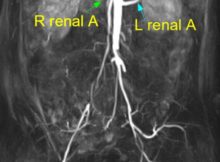
MR angio of aortoiliac disease
Magnetic resonance (MR) angiography of aortoiliac disease has the advantage that no contrast has to be administered and hence suitable in individuals with renal dysfunction. Contrast is provided [..]

Cardiovascular magnetic resonance imaging to assess need for coronary angio in heart failure
Persons presenting with heart failure and no overt features of coronary artery disease like angina are often considered for a diagnostic coronary angiography to exclude an ischemic and [..]
Prediction of reversibility of constrictive pericarditis by magnetic resonance imaging
The usual treatment of constrictive pericarditis is pericardiectomy. But constriction can also be reversible in certain instances. Feng D and associates have conducted a pilot study to assess [..]
Nephrogenic systemic fibrosis
In earlier years, magnetic resonance imaging was considered as a safe modality of imaging in those with renal failure because it did not have the potential for contrast [..]
Plaque rupture and ulceration common in females with myocardial infarction and non obstructed coronaries
Coronary angiography after a myocardial infarction sometimes do not show significant obstructive lesions, more so in females. Reynolds HR and colleagues evaluated the mechanism of myocardial infarction in [..]
MR angio of aortic bifurcation and lower limb arteries
MR angio of aortic bifurcation and lower limb arteries Magnetic resonance angiography is a non invasive technique which enables excellent visualization of the peripheral arteries. Upper most region [..]
Intra coronary thrombus detection by cardiac magnetic resonance (CMR) imaging
Intra coronary thrombus is usually detected by conventional coronary angiography as a negative shadow with haziness. Direct imaging of the carotid thrombus and hemorrhage within the plaque has [..]
MR angio of anterior and posterior tibial arteries
MR angio of anterior and posterior tibial arteries Popliteal artery terminates below the knee joint by bifurcating into anterior and posterior tibial arteries which supply the leg. Anterior [..]
Role of cardiac magnetic resonance imaging (CMR) in the evaluation of GUCH
Cardiac magnetic resonance imaging (CMR) has the advantage that it is less operator dependent than echocardiography regarding the acquisition of images. But when it comes to interpretation, experience [..]